
I’ve been a content marketer and strategist in blockchain since 2018. I’ve produced more than 2,000 articles, 170 podcast episodes, 110 X Spaces, and 80 on-the-ground interviews at conferences. In the eight and a half years I’ve been working in the industry, I’ve learned a lesson the hard way: publishing more content does not make an effective content strategy.
Each piece of content serves an objective in a bigger system
I have come to think of each piece as a job that fulfills a specific objective in a broader system of capturing attention and disseminating information. Some jobs are bigger than others, but each piece of content fits into a cohesive structure that feeds into other parts. Content is not the end goal in and of itself. For example, a short-form video (the job) briefly catches a Twitter or LinkedIn scroller’s attention (the objective), but a long-form podcast (the job) satiates the person who wants to know every detail (the objective) they can about a project (the system). Each has its own objective, and together they form the system.
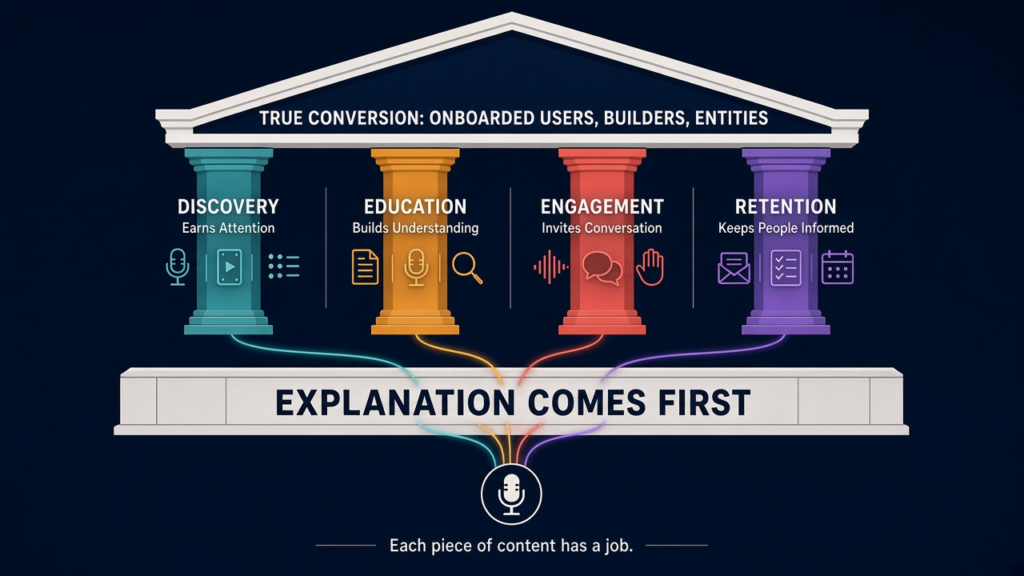
This article sets out the four pillars, where each pillar has an objective in the system and contains specific jobs, that I use for identifying which type of content is oriented to a part of the user engagement funnel: discovery, education, engagement, and retention.
It also explains how a single job can serve more than one pillar.
Publishing is not the same as a strategy
Many content teams measure output. They count articles, posts, and videos (the job). That number tells you very little about whether anyone is learning anything.
Side note: I would argue impressions are also vanity metrics that don’t necessarily highlight true conversion, which in the blockchain space is all about onboarding a new user, developer, or entity.
I can write every article (the job) I want. If the writing does not connect with an audience (the objective), nobody will read it. Nobody will go deeper into what is happening in the ecosystem (the objective). Instead, I should also derive content (the system) from that article (the job), which can include quotes for a tweet (the job), or a short-form video (the job).
Volume is not the goal, because it doesn’t translate to true conversion (the objective). The article isn’t the end result, it’s a part of the content creation process (the system).
Explanation comes first
Though cool to hobbyists, for the vast majority technology does not sell itself. I have learned that even the coolest and most innovative technology needs explanation (the objective).
A great product still confuses people if they cannot see why it matters.
My own experience highlights this gap.
I first got into crypto and blockchain in 2017, while learning about the basics of personal finance (i.e., IRA’s, 401k’s, index funds). A lot of the forums I was learning from claimed Bitcoin was a scam. It took a lot of learning before I could judge those claims for myself. Ultimately, I determined that Bitcoin wasn’t a scam; it was just misunderstood.
Explanation is part of the product. Content that explains the product (the objective) is part of the overall Four Pillar System, not an extra. Our Ideal Customer Profile (ICP) needs to be attracted first; they need to discover the project.
Pillar one: discovery
Discovery is how we earn attention. It is the work of reaching the people we want in the ecosystem. Those people include builders, users, and token holders.
We cannot educate people who do not know we exist. So the first task is to create content that makes them aware of the project and its builders.
Anecdotally, conference interviews (the job) have been my most reliable source of discovery content. They give unfiltered, unscripted, and raw conversations, and they show the founder, the product lead, or the developer as a person. When we’re live on the conference floor, often going off a barebone question list, the conversation is more natural, like we’d have with friends at a party or over dinner. The viewer gets to see how the guest responds to real-life events, such as someone interrupting the interview walking through the frame, and how they deal with it. It humanizes the founder, and fosters more of a personal connection (the objective) with the person on the other side of the screen.
Podcasts (the job) serve a similar function, but with a caveat. One long interview can produce several short clips (the system). Each clip is a window into who the builder is and why they build (the objective). Podcasts allow the founder to provide a prepared, pre-scripted thought process to their product, and the host to ask more well-informed questions (assuming they prepared well ahead of time).
Short clips (the job) work well on social platforms. They do not need to convert a viewer into a full listener on their own. They give people a reason to look further (the objective). They help the viewer discover a person, place, or idea (the objective).
Pillar two: education
Education builds understanding (the objective). Once people have found you, your team, or your product, they need to know why the project matters.
Articles (the job) give you time to research a project, back up an argument with facts, and convey that information how you see fit. Good writers can spend hours researching, drafting, and editing a 500-word article that has sources for every claim made. A good article (the job) should answer every question the reader will have, or send them to the source where they can spend more time digging around (if they so choose to do so) (the objective).
But podcasts (the job) give you a different kind of room. A conversation can go deeper, and you can ask the difficult questions.
That being said, a good podcast episode depends on preparation. The best piece of advice I ever got on podcast hosting was from Kevin Owocki. He said, “Show your guests you researched them. Don’t tell them.”
I always spend at least 45 minutes learning about a guest before a recording, and I plan a path of questions. After we hit record, once the guest is warmed up and talking about their history, the harder subjects become easier to explain. Their reasoning and logic comes out more naturally.
For example, here’s a rather difficult concept for the uninitiated to grok. Trying to explain Proof of Work as a consensus mechanism, and why Bitcoin uses it, is difficult to do in thirty seconds. In a podcast, you can lead the guest through the problems and research that came before Proof of Work. By the time they reach the answer, the audience is ready for it.
Podcasts can also become articles (the system). One example from this year started with an interview with Etherealize, which works with traditional institutions on blockchain and tokenization. The team there had released a report on ETH as a productive form of money. We drafted a LinkedIn article from the transcript (the system). The draft used AI for much of the heavy lifting, and a human editor reviewed it before it went out. It was one of the most productive essays we published from a podcast episode that year. On LinkedIn, that article earned us 2,300 impressions and got 83 click-throughs to our podcast page, which is just shy of 440 followers.
Pillar three: engagement
Engagement turns information into conversation (the objective). A podcast or an article (the job) is one-way. People need a way to answer back, ask questions, and disagree (the objective).
Forums and Reddit have worked great in the past, but we’re moving toward an audio- and visual-driven world.
I try to meet the social media market where it’s at with weekly X Spaces (the job), an audio-only media format that’s hosted natively on the X (formerly Twitter) platform and is native for crypto and blockchain users. Some of the Spaces hosted on our podcast page have attracted large audiences and listenership. I’ll also be the first to admit, some Spaces have been flops. The best ones draw on what I have learned from the podcast and from research. They also draw on the contacts I have in the industry. The flops have happened for two reasons. First, the subject matter wasn’t too engaging for the listeners. Second, the account we hosted the X Space (the job) on has less than 1,500 followers, limiting natural reach.
Spaces can also show what the community wants (the objective). Questions and disagreements from listeners should be welcomed, because they can become future content (the system). Once people raise a question or objection, they are making your job easier because they are telling you what to make next.
Spaces (the job) are informal, and that is part of their value. One of my most popular Spaces came from a guest and friend who was playing around with the VIRTUALS token and project. They’d been active in that ecosystem for a few months and had some insights to share. I want to highlight that my co-host and I were not trying to manufacture a viral moment. However, the VIRTUALS project had been trending at that point in time, and we’d simply invited someone who had experience with the project.
Lastly, in addition to new content ideas, engagement is also where a founder can test an argument (the objective). A question or a disagreement can make an argument stronger, if the founder is willing to answer it (the objective).
Pillar four: retention
Retention, the fourth and final pillar, keeps people informed (the objective). With so much going on in our lives, no one has time to monitor every corner of an ecosystem. No one can read every post that every builder writes.
My answer to keeping ecosystem participants retained is a weekly newsletter (the job). I go through the builders in one ecosystem and keep track of what they are doing. I maintain a private list on X of people building in that ecosystem, and I review it every week. The newsletter (the job) collects what matters into one place, so readers do not have to scan many channels each day (the objective).
Editorial judgment for what gets included is the hard part. A good content marketer decides what matters, what needs context, and what to leave out.
Most importantly, consistency matters more than anything. A quiet week still deserves a newsletter (the job). In a quiet week, the builders keep building, and they need to be highlighted (the objective) for their benefit, but also for the user we seek to maintain.
How the four pillars fit together
The four pillars are a general concept, not a rigid funnel, but each serves a different objective.
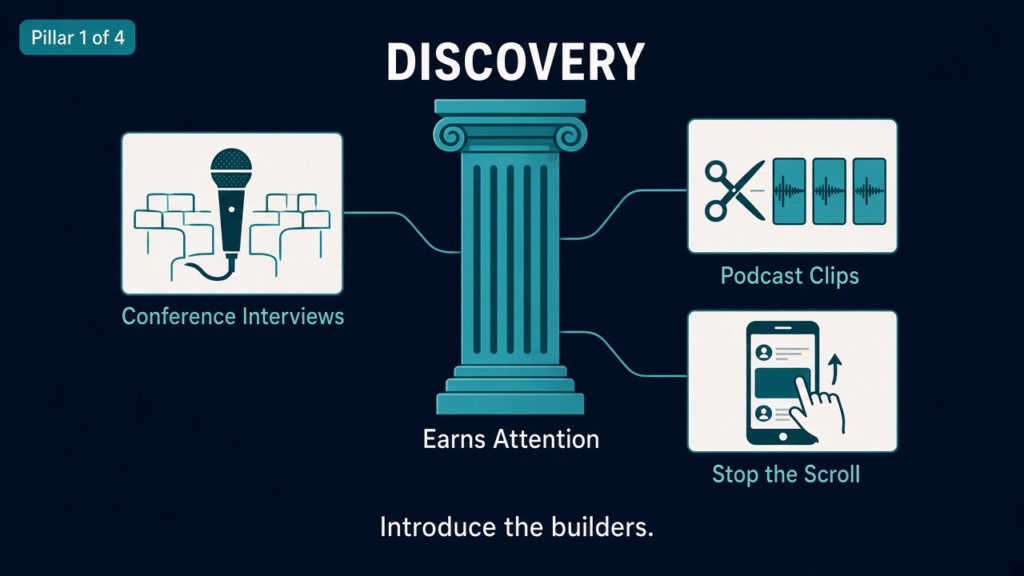
Discovery earns attention, by meeting people where they already are and creating content that introduces the builders. I measure discovery by how many new people a piece reaches, not by raw impressions. I look at views from non-followers, how long people watch a clip, and whether the guest reshares it. Then I check whether viewers click through to the full episode or follow the page.
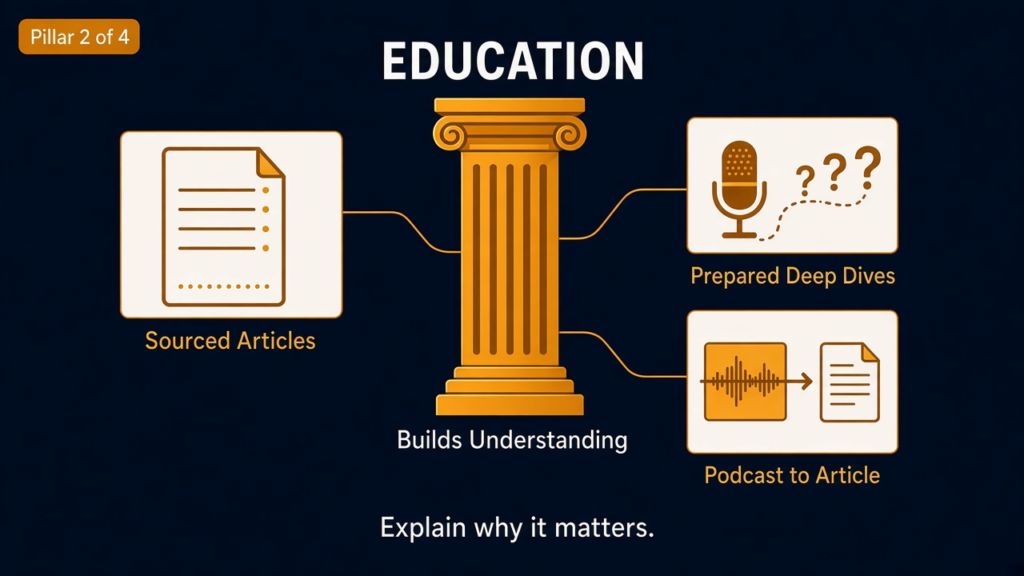
Education builds understanding, by explaining the product, the project, and the person in plain language. Education is about understanding, so I measure depth over reach. I track episode completion, time spent on articles, and how often people save them. The hand-off I watch is the click-through to the podcast or the project itself.
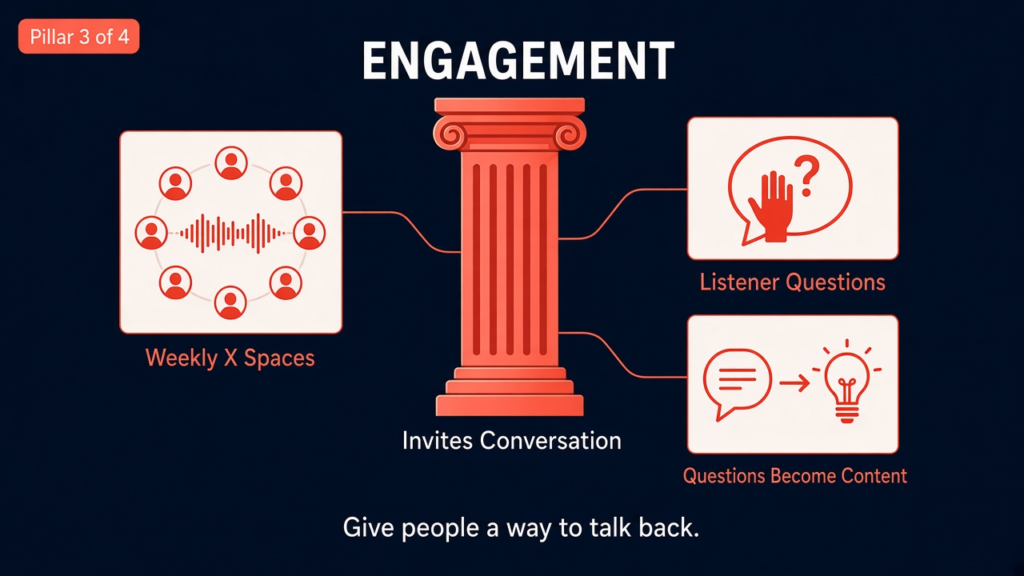
Engagement supports participation, by giving the community a way to talk back. For engagement, I measure whether people talk back. I count live listeners, questions, and speaker requests in each Space. I also track how many listener questions became future content, and how many people come back the next week.
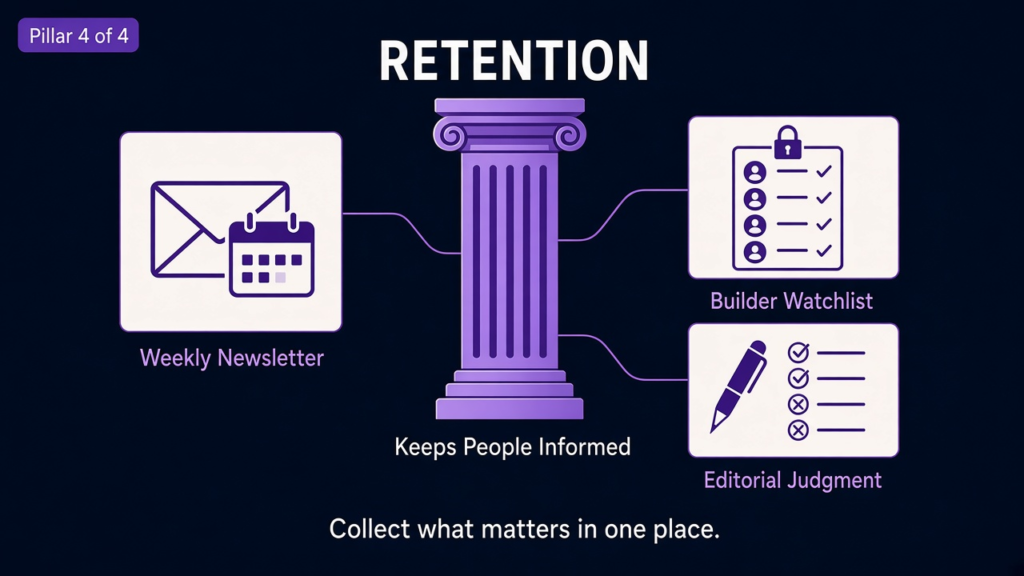
Retention keeps people informed, by collecting what matters so readers do not have to look everywhere. I measure retention by whether readers stay and act. I track newsletter click rate, unsubscribes, and replies rather than opens, since opens are unreliable. I also track my publishing streak, because consistency is part of the job.
One job can serve several objectives. A single long-form podcast episode (the job) can produce a LinkedIn article (the system). It can also produce several short clips for different platforms. It can start a conversation in a Space and earn a mention in the newsletter.
Each job has its own objective, even when the source is the same.
These four pillars of content marketing are a pattern, not a promise. A campaign built this way is not guaranteed to produce millions of impressions or hundreds of new clients overnight. The point is to know each job’s objective, and to measure the job against it.
One Job, Many Pillars
This isn’t a neat concept tied into a bow, it’s not one-for-one, but rather a loose guide, a system that grows and contracts with itself. Every piece of content relies on everything else. One job can be part of each pillar.
Conclusion
Building an understanding of this sort of system is difficult, and takes time. First, we need to learn how to create each piece of content, and do it well. Then, we need to learn how to do that consistently and the channels that each piece needs to be shared on. Lastly, we need to then be able to repurpose content for the various channels.
Builders and founders can do this for themselves, especially with the modern integration of AI tooling, but using AI requires two things. First, taste. The engineering-oriented founder will need to deploy tact and taste that social media to which users are accustomed. Second, time. The technical CEO or the founder of a development project needs to take time away from doing what they do best, building their product and company, to deploy a content marketing strategy.
If any of this resonates with you, my DMs are always open to start a dialogue.