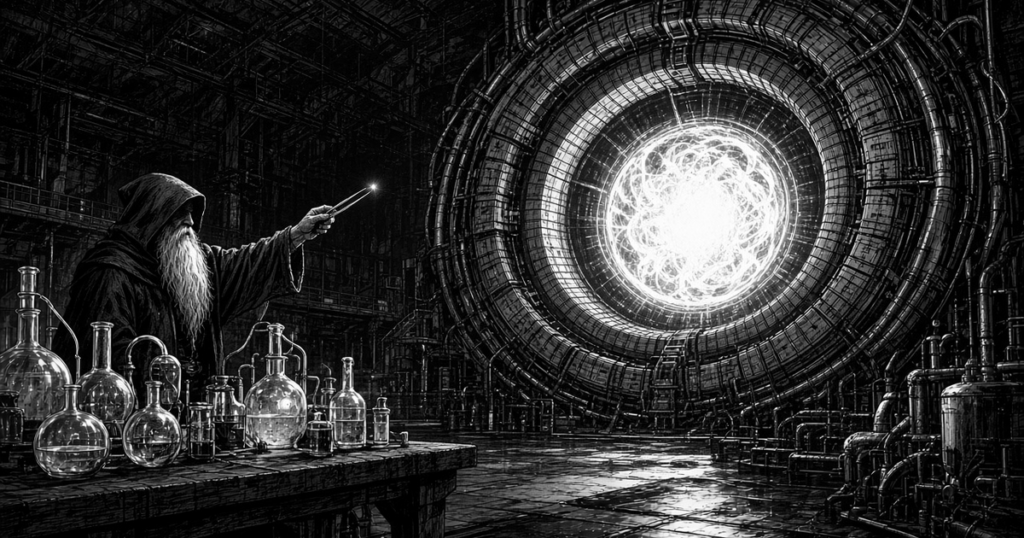
Maybe Bitcoiners were right, and BTC is the hardest asset.
A fusion startup says it turned mercury into gold. CT immediately declared gold’s scarcity over.
It isn’t. But it gives me a good excuse to explain what actually makes gold and Bitcoin scarce.
(Note: I used AI to help me with the science-based parts of this article.)
What Actually Happened
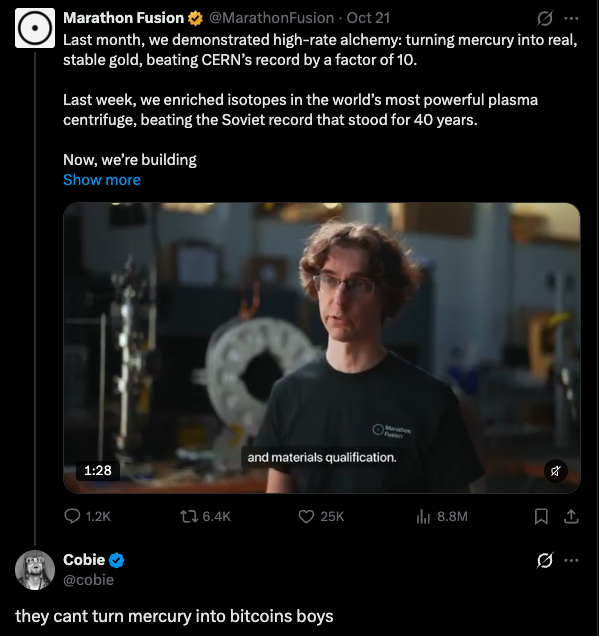
On Oct. 21, Marathon Fusion posted that it turned mercury into stable gold “last month” using fusion neutrons. The San Francisco startup, founded in 2023, claims it beat CERN’s record “by a factor of 10.”
Marathon hasn’t said how much gold it made, what it cost, how pure it is, or who checked the work. There’s no new paper. The publicly shared evidence consists of gamma-ray charts taken 8 to 44 hours after the run.
For scale, CERN’s ALICE experiment measured the LHC’s gold output from 2015 to 2018. Its four big experiments made about 29 picograms combined, and that gold fell apart almost instantly.
Marathon hasn’t disclosed the size of its haul. Not enough evidence to send goldbugs into a tizzy, yet.
How You Make Gold With Fusion
- A deuterium-tritium fusion reaction throws off a fast neutron.
- That neutron hits mercury-198 and knocks a neutron out, leaving mercury-197.
- Mercury-197 decays into gold-197.
- That decay has a half-life of about 64 hours, so half of the mercury-197 converts in that window.
The mercury sits in the “blanket” around the plasma, which also helps the reactor breed its own tritium fuel. So in theory, the gold is a side product of a power plant.
“In theory” is doing a lot of heavy lifting here. The proposed gold-producing power plant only exists in a preprint that still hasn’t been peer reviewed.
Where the Tonnes-per-Year Numbers Come From
The big numbers going around come from Marathon’s July 2025 preprint, a paper posted before peer review. The results come from a computer simulation. Nobody has built the thing.
The paper models a 1.5 GW (thermal) fusion plant producing roughly 3 t of gold a year. If you’ve seen “5 tonnes,” that’s the same production concept expressed per GW of electricity rather than thermal power. The output didn’t get bigger.
The catches, all from the paper itself:
- It needs mercury enriched to 90% mercury-198. Natural mercury is about 10%.
- The gold comes out mixed with radioactive isotopes.
- About 6.8 years for the modeled gold mixture to reach the least hazardous waste class.
- About 13.7 years to fall below the threshold requiring radioactive labeling.
- About 17.7 years before an ounce is less radioactive than a banana.
Also, the plant doesn’t exist. Marathon lists a 1 kW fusion-power target for its smaller reactor, and the company says its near-term business is medical isotopes.
The alchemy is the marketing plan. Medical isotopes are the business plan.
Why This Can’t Crash Gold
Mines produced about 3,672 t of gold in 2025, per the World Gold Council. About 222,600 t sit above ground. A simulated 1 GW (thermal) plant would add about 0.05% of annual mine output.
Marathon’s own paper says it would take about 1.65 TW of fusion heat to match one year of mining, using 2024 production figures. That’s more than 1,000 fusion plants of the size it modeled. The number of commercial fusion power plants on Earth is still zero.
Lab-grown diamonds are the comparison I keep seeing.
Their wholesale prices have fallen 90–95% since 2015, according to analyst Paul Zimnisky. But diamonds are priced in large part on being rare. Gold is a deep, liquid stockpile that grows slowly, so a trickle of new supply barely registers.
Gold’s drop this week had nothing to do with this either. Spot closed at approximately $4,000 on Oct. 23, about 26% below January’s record. Analysts have pointed to interest-rate expectations and broader market pressures, including uncertainty around the AI trade.
Gold’s Supply Cap Is a Price Tag
This is the part crypto people should care about.
Gold isn’t scarce. It’s expensive to make more of. Mined supply grows about 1.65% a year.
Bitcoin’s issuance is about 0.82% a year right now, roughly 164,000 BTC out of an existing supply of about 20.1 million.
Stock-to-flow is existing supply divided by new supply each year. By that measure, gold sits at about 61 years of production above ground. Bitcoin sits at about 122.
Gold’s ceiling is its cost of production. Miners’ all-in sustaining cost was $1,785/oz in Q1 2026, per the World Gold Council. When gold trades far above that, miners dig harder.
A new way to make gold only matters if it’s cheaper than digging. Fusion gold has no published cost per ounce. Add a modeled 7- to 18-year cooldown, depending on the radioactivity threshold, before it reaches various handling and regulatory benchmarks.
Bitcoin’s ceiling is a rule. Nobody’s building a reactor that makes more of it. Cobie put it best: “they cant turn mercury into bitcoins boys”
Even 100 fusion plants would add about 500 t a year at Marathon’s own 5 tonnes per gigawatt of electricity, assuming each generated 1 GW of electricity. That pushes gold’s supply growth from about 1.65% to under 1.9%.
The Takeaway
Alchemy works. It’s been demonstrated in picograms, and nobody outside Marathon has publicly verified its latest claim. The paper’s own math says its modeled gold output can remain radioactive for over a decade.
Gold’s scarcity was always an economics story. Physics never guaranteed it.
Bitcoin swapped the economics for code.
Originally published in The Smart Economist.